
Hawaiian bird uses feet to drill for food
New research reveals that the 'akiapōlāʻau relies on a specific ankle tendon to power its drilling movements, a mechanism distinct from woodpeckers.
By Daphne Turner ·
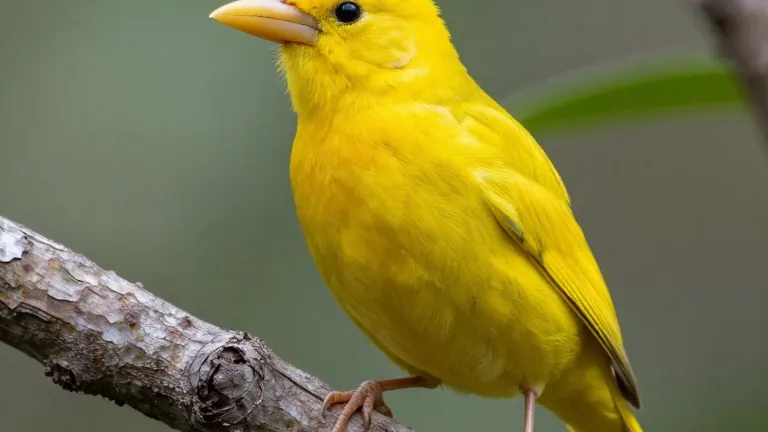
Researchers have determined that the 'akiapōlāʻau, an endangered yellow bird found in Hawaii, does not rely on its neck to drill for food. Instead, the bird uses its entire body and a large tendon in its ankle to generate force. This finding clarifies how the species survives in a niche that seems impossible for a bird with such an unusual bill.
The study, which used data from the Field Museum of Natural History in Chicago, details the mechanics of the 'akiapōlāʻau's feeding behavior. The bird possesses a bill that functions as two separate tools. The upper mandible is long, narrow, and flexible, designed to probe for grubs in branch cavities. The lower mandible is short and broad, acting as a chisel to bore into wood. This dual-function bill has led scientists to compare it to a Swiss Army knife.
Alexander Clark, a Ph.D. candidate at the University of Chicago and lead author of the study, noted that the bird's anatomy is unique among all known species. "The Aki is unique from every other bird that has ever evolved, and not just in Hawaii, it has features unseen in any birds," Clark said. Previous scientific understanding covered the structure of the bill but left the physical mechanics of drilling unclear.
The new data shows that the bird anchors itself to the branch and then uses its ankles to bend upward. This motion allows the bird to drop its whole body downward with force, similar to swinging an axe. This mechanism is distinct from woodpeckers, which primarily use neck muscles to hammer into trees. Woodpeckers are not native to the Hawaiian Islands, making the 'akiapōlāʻau's evolutionary path even more distinct.
Paul Banko, a co-author of the study and former researcher at the USGS Pacific Island Ecosystems Research Center, explained that intense competition drove this specialization. When Oahu emerged from the ocean, a rapid increase in animal species created pressure to find new food sources. "For a bird like the 'akiapōlāʻau to evolve, there had to have been intense competition in the ecosystem," Banko said. The species evolved to exploit resources, such as caterpillars, that other birds could not easily reach.
The 'akiapōlāʻau is now restricted to the northeastern slope of a single mountain on the island of Hawaii. Experts estimate that fewer than 2,000 individuals remain in the wild. The study provides a clearer picture of how this rare bird functions in its specific environment, offering insights into its evolutionary history and physical capabilities.