Texas map redraws shift five seats
Mid-decade redistricting in Texas sparked national legal battles and a quorum fight among state legislators.
By Daphne Turner ·
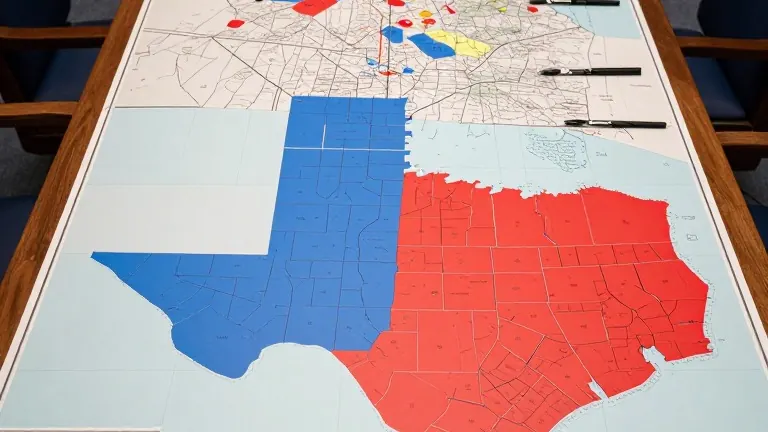
Five congressional seats in Texas changed hands in a recent map redraw designed to favor the Republican Party. The new districts, unveiled by the Texas House, feature shapes that have drawn public attention, with District 33 resembling a butterfly and District 9 looking like a cartoon whale. These visual quirks have reignited debate over gerrymandering, a practice that dates back to 1812 when Governor Elbridge Gerry of Massachusetts signed a bill creating a salamander-shaped senate district.
The current push began in the summer of 2025 when President Donald Trump requested that Texas redraw its congressional map. The goal was to secure up to five additional seats for Republicans ahead of the 2026 midterm elections. Mid-decade redistricting is unusual, as states typically only update maps after a census to account for population shifts. However, the administration sought to prevent a potential Democratic majority from blocking the president's agenda in the U.S. House of Representatives.
Governor Greg Abbott directed state lawmakers to return to Austin to implement the changes. Weeks later, the Texas House presented a plan that would flip five blue districts to red. Democratic lawmakers initially fled the state to break the quorum, a legal requirement of 100 of 150 members needed to vote. After a few weeks of delay, the Democrats returned to Austin, and the new map passed into law.
This move triggered a chain reaction across the country. Matthew Wilson, a political science professor at SMU, described the situation as a partisan tit for tat. California and other states responded to Texas' actions, leading to a cascade of redistricting efforts between Democratic and Republican states. Wilson noted that while the goal is often to create neat districts, the primary objective has become drawing lines that advantage specific political interests.
Gerrymandering remains legal despite public skepticism. A 2019 Supreme Court ruling determined that excessive gerrymandering is not unconstitutional, leaving federal courts without the authority to intervene. The practice often involves cracking, which dilutes voter power by splitting groups across multiple districts, or packing, which concentrates a group into fewer districts to limit their influence elsewhere. Although 71 percent of Americans said states should not draw maps that favor one party, Wilson observed that most voters are preoccupied with other issues.
The recent battles have raised the stakes for the upcoming elections, though some experts warn that partisan efforts could backfire. Wilson suggested that voters generally prefer competitive elections where districts can go either way. He noted that when districts are overwhelmingly one color, the primary election in March becomes the decisive contest, reducing the impact of the general election.
Source: KTVT · original report published
More Politics · Dallas news · Report a business · Got a Story?