63-Minute Texas Execution Sparks Scrutiny of Lethal Injection Process
Prison officials reported difficulties placing intravenous lines during the November 19 execution of Reinaldo Dennes, leading to renewed debate over execution methods.
By Nathan Brooks ·
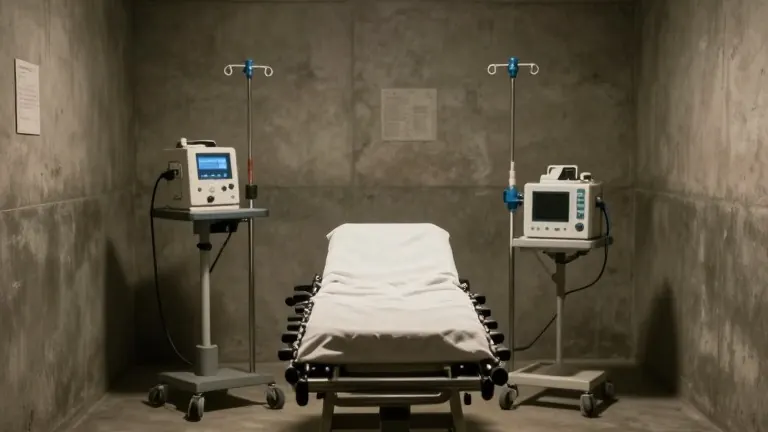
Reinaldo Dennes died at 7:08 p.m. on November 19 at the Huntsville Unit, concluding a 63-minute execution process that drew attention to procedural difficulties. Texas Department of Criminal Justice spokesperson Amanda Hernandez stated that staff placed intravenous lines in Dennes’ left foot and the left side of his neck after several unsuccessful attempts. The prisoner, 70, was executed for the 1996 robbery and murder of Houston diamond dealer Janos Szucs.
AP correspondent Michael Graczyk, who witnessed the event, reported that Dennes cried out, “The pain!” shortly after the procedure began. Graczyk observed the inmate moaning for nearly three minutes and complaining about pain in his right leg. Hernandez noted that Dennes also described pain before drugs began to flow and in areas without intravenous lines, leading the agency to question the source of the distress. The department has not publicly determined whether the medications or the line placement caused the reactions.
The incident occurs amid ongoing questions about the reliability of lethal injection. In Tennessee, a September 30 attempt to execute Christa Gail Pike failed when she survived two doses of pentobarbital. Pike’s attorneys argued that malfunctioning intravenous lines caused the drugs to leak into her tissues rather than circulate properly. Tennessee Governor Bill Lee suspended the state’s remaining 2026 executions pending an independent review. A federal court is scheduled to hear a motion regarding Pike’s confinement on December 1.
Historical data suggests lethal injection has a higher rate of procedural errors compared to other methods. A study by Amherst College professor Austin Sarat analyzed 8,776 U.S. executions from 1890 to 2010. The research classified 7.2% of lethal injections as botched, compared to 3.12% of hangings. The study identified no botched firing squad executions among 34 cases, though some historical accounts dispute this finding. Recent autopsies, including one from South Carolina in April 2025, have revealed that firing squads may also miss intended targets.
Texas has used lethal injection since 1977, carrying out the state’s first such execution in 1982. Current state law, specifically Article 43.14 of the Texas Code of Criminal Procedure, mandates intravenous injection of lethal substances. Prison administrators cannot unilaterally switch to hanging or firing squads; legislators must pass new laws to change the method. Legal standards under the Eighth Amendment generally require evidence of a substantial risk of severe pain and a feasible alternative to deem a specific execution unconstitutional.
Dennes’ execution was authorized after the U.S. Supreme Court denied his application for a stay on November 19. The court’s ruling did not evaluate the specific manner in which officials carried out the execution. No court has ruled that the November 19 procedure violated the Eighth Amendment, though the event may influence future scrutiny of intravenous procedures and staff training in Texas.